


Your cart
There are no more items in your cart

The laboratory desiccator is one of those discreet yet essential instruments that ensures the integrity of many analytical samples. Although its appearance may seem simple, its function is critical when handling moisture-sensitive materials. In this article, we will explore what a laboratory desiccator is used for, how it is operated, its components, types, and benefits. We will also link to related Pobel products so you can find the ideal model for your needs.
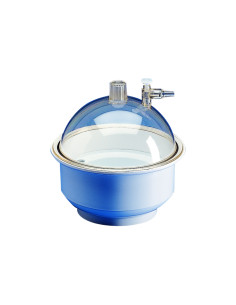
A laboratory desiccator is an airtight container designed to create a dry and controlled environment. Its basic structure consists of:
The most common materials are:
At Pobel, you can find both glass desiccators and plastic desiccators, suitable for different laboratory environments.
Preserving Moisture-Sensitive Samples
The main function of a desiccator is to preserve chemical, biological, or industrial samples that could be altered by ambient moisture. The desiccant agent (such as silica gel or calcium chloride) absorbs humidity and keeps the internal atmosphere dry. This is crucial for:
Vacuum Drying
Vacuum desiccator models allow for faster and more efficient dehumidification by extracting air. By lowering the pressure, sample drying is facilitated and residual solvent traces can be removed. This type of desiccator is used when more intensive drying is required or when samples are especially sensitive.
The use of a desiccator is common in various disciplines:
Whether used for drying, storing, or preserving, the laboratory desiccator is a versatile, safe, and cost-effective tool. It can serve as a practical alternative to drying ovens in certain scenarios and offers a passive, power-free solution when heat is not needed.
1. Preparation
Ensure the desiccator is clean and dry. Place the desiccant in the lower chamber. Some desiccants change color when saturated, helping monitor their status.
2. Introducing the Samples
Place the samples on the inner plate, avoiding direct contact with the desiccant.
3. Closing the Desiccator
Close the lid firmly to ensure an airtight seal. If the desiccator has a vacuum valve, make sure it is closed before applying vacuum.
4. Applying Vacuum (Optional)
In vacuum desiccator models, connect a pump and extract the air. This speeds up the dehumidification process and enhances the desiccant's performance.
5. Maintenance and Precautions
Desiccators can be classified according to their material, shape, and technology:
Each type offers particular advantages depending on the use. We invite you to browse our desiccator category to find the most suitable model.
It depends on the application, but the most common are:
Yes, some desiccants like silica gel can be regenerated by heating them to around 120 °C for a few hours.
No. It is only needed when rapid moisture removal is required or when samples are extremely sensitive.
You can check this by using a pressure gauge (if available) or by trying to lift the lid—if vacuum is present, it will resist. You can also monitor the condition of the desiccant.

 Quick delivery
 High quality
 Safe payment