

Your cart
There are no more items in your cart
Decantation beakers are tall, cylindrical vessels without a spout or stopcock, designed to harness simple gravity for separating sedimented solids or immiscible liquids. Their straight walls create a homogeneous liquid column, allowing clear phase boundaries to form and be observed without optical distortion. These laboratory beakers are made of borosilicate 3.3 glass, withstand thermal shocks over 200 °C, and remain inert to most acids, bases, or organic solvents. This prevents ion leaching that could alter analytical results, even when mixtures are heated prior to decantation.
Annealed borosilicate 3.3 glass to eliminate internal stresses.
Extra-thick flat base provides stability on balances and evenly distributes heat when tempering samples.
Fire-polished rim minimizes micro-chipping and facilitates cleaning.
Full optical clarity, essential for detecting fine separation lines or light flocculates.
Standard capacities: 50 ml, 100 ml, 150 ml, 250 ml, 400 ml, 600 ml, 1,000 ml, and 2,000 ml, in compliance with ISO 3819. Each volume is calibrated ±5% for reproducibility across laboratories.
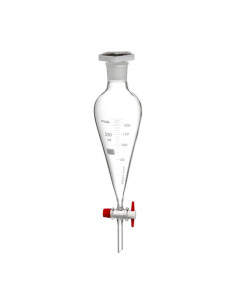
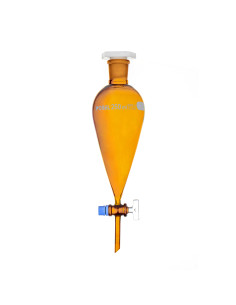
| Criterion | Decantation Beaker | Separatory Funnel |
|---|---|---|
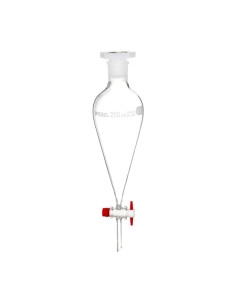
| Moving parts | None | PTFE or glass stopcock (prone to leaks or jamming) |
| Cleaning | Quick, no valve disassembly | Slower; requires disassembly and drying |
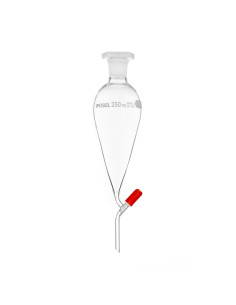
| Transfer | With pipette or siphon: precision aspiration | Gravity drain: potential emulsion formation |
| Very small volumes | Excellent (≥10 ml) | Less precise; retention in stopcock |
| Acquisition cost | Lower | Higher |
Temper the mixture to 25–30 °C: optimal viscosity aids sedimentation.
Pour slowly down the inner wall to prevent emulsions.
Cover with a watch glass and let it settle until the phase boundary stabilizes.
Measure the height of each phase with an adhesive ruler to track progress and calculate sedimentation rate.
Aspirate the desired phase using a Pasteur pipette or Luer-Lock syringe, starting 3–5 mm above the separation line and lowering gently.
Record time and temperature, as these variables directly affect reproducibility.
Wash immediately with neutral detergent, rinse with distilled water, and air dry to remove residual surfactants.
Analytical Chemistry: Clarification of solutions containing solid catalysts or activated carbon.
Environmental Control: Determination of settleable solids in wastewater (modified Imhoff standard).
Food Industry: Separation of fat and whey in dairy, or decantation of aromatic oils in distillation.
Pharmaceutical and Cosmetics: Stability testing and phase separation in O/W and W/O emulsions.
Biotechnology: Recovery of cell-free supernatants before chromatography.
Effective decantation depends on relative density and particle size. To accelerate sedimentation:
Add flocculants or adjust pH if the sample’s chemistry allows.
Increase temperature (if the product is non-volatile) to reduce viscosity.
Use a taller decantation beaker to increase particle settling distance.
Let us know your volume range, fluid types, and working temperature; our technical team will prepare a detailed quote and recommend the Pobel reference best suited to your protocol. All beakers are supplied with a certificate of conformity and protective packaging to prevent microdamage during transport.
Explore the full range and start separating phases with the precision and simplicity that only Pobel glassware can offer.
 Quick delivery
 High quality
 Safe payment