


Your cart
There are no more items in your cart
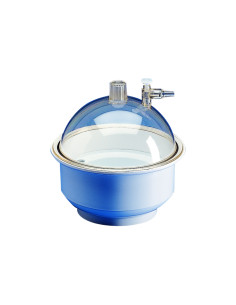
In the dynamic environment of modern laboratories, the need to protect samples and reagents sensitive to moisture is constant. However, not all settings or applications allow for the use of fragile equipment. This is where laboratory plastic desiccators emerge as a robust and efficient alternative to traditional glass models, offering an ideal combination of durability, lightness, and functionality. These units are crucial for maintaining a controlled, moisture-free atmosphere, ensuring the integrity of hygroscopic materials, calibration standards, and electronic components.
Plastic desiccators, commonly made from high-quality polycarbonate, polyester, or polypropylene, have gained popularity due to their exceptional impact resistance. Unlike their glass counterparts, they are nearly unbreakable, minimizing the risk of accidents, loss of valuable samples, and downtime caused by breakage. This makes them especially suitable for high-traffic environments, educational settings where frequent handling is common, or industrial applications where ruggedness is a top priority.
Incorporating them into your lab not only ensures effective protection of your materials but also represents a smart investment in safety and operational efficiency. Their light weight makes them easy to handle and relocate within the lab, contributing to greater flexibility in workspace organization.
Beyond their obvious resistance to breakage, they offer a range of operational advantages that make them highly attractive for a broad spectrum of applications. Their design and materials contribute to a safer and more practical user experience, optimizing daily workflows.
One of the key benefits is their significantly lower weight compared to similarly sized glass desiccators. This lightness greatly facilitates handling and transport, which is particularly useful when organizing or reorganizing workstations, or when transferring samples between different lab areas. Additionally, many polycarbonate models offer superior transparency—comparable to that of glass—allowing clear visibility of the contents and desiccant without compromising the airtight seal.
Their design often includes removable trays and shelves that maximize storage space and enable modular sample organization—essential in high-throughput laboratories. The non-porous surface of high-quality lab-grade plastics also simplifies cleaning and decontamination, helping maintain a sterile and safe work environment.
They include a connection (such as a stopcock or valve) that allows the internal air to be evacuated using a vacuum pump. The ability to generate vacuum is key for accelerating the drying of thermolabile samples at room temperature, preventing thermal degradation. They can also achieve and maintain extremely low residual humidity levels, crucial for preserving highly sensitive materials, analytical standards, or storing components that require an almost anhydrous environment. While glass desiccators are traditional for vacuum use, plastic models offer unmatched break resistance—a significant advantage in applications where safety is critical. For specialized needs, consider our vacuum-equipped plastic desiccators.
To optimize the functionality of laboratory plastic desiccators, certain accessories are essential and ensure top performance.
Desiccator Plates: These perforated discs, usually made of porcelain or polypropylene, are placed inside the desiccator to elevate the samples above the desiccant. Their perforated design is crucial for ensuring even air or vacuum circulation, allowing the low-humidity atmosphere to reach all samples uniformly. They also protect the samples from direct contact with the desiccant. Selecting the right desiccator plate is vital for drying efficiency and sample organization.
Vacuum Valves for Desiccators: Designed for vacuum models, these valves control the passage of air or vacuum into the desiccator. Made from durable materials that ensure an airtight seal, they allow precise handling to create, maintain, and release vacuum in a controlled manner. A high-quality valve is indispensable for system safety and the stability of internal conditions, preventing leaks and vacuum loss. Choosing the appropriate vacuum valves for desiccators is a critical factor for optimal performance.
Investing in laboratory plastic desiccators is a strategic decision that enhances safety and operational efficiency. Their impact resistance, lightweight nature, and versatility make them an ideal solution for protecting your sensitive materials across a wide range of applications. When selecting your desiccator, consider the nature of your samples, the frequency of handling, and whether you require vacuum capability or atmospheric storage.
At Pobel, we are your trusted partner in laboratory equipment. We offer top-quality products designed to meet the highest standards of safety and performance. Our technical team is available to advise and assist you in choosing the desiccator that best fits your needs and optimizes your processes.
Ready to ensure the integrity of your samples with durable and efficient solutions?
Contact us today for a personalized consultation and discover how to enhance the safety and reliability of your work with our products.
 Quick delivery
 High quality
 Safe payment