

Your cart
There are no more items in your cart

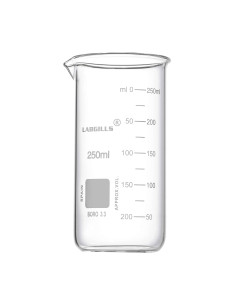
The tall-form beaker, known as the Berzelius beaker, is the preferred choice when processes require deep volumes, minimal evaporation, and impeccable phase separation. Manufactured by Pobel from borosilicate glass 3.3, it withstands thermal shocks over 200 °C and resists acids, bases, and hot organic solvents without altering the sample or releasing contaminants. The glass's optical clarity allows you to monitor precipitate formation, bubbling, or color changes with complete accuracy—even after dozens of autoclave cycles.
With a height-to-diameter ratio close to 2:1, the liquid is concentrated in a tall, slender column that reduces the surface area exposed to air. The result is a lower evaporation rate and more efficient gravity-based decanting, as solids or immiscible phases have a longer path to settle without turbulence. The spout, integrated during blowing, ensures a smooth and even pour. The rolled rim reinforces the most impact-prone area, while the vitrified graduation remains legible even after exposure to alkaline detergents or pressurized steam.
Available capacities: 25 ml, 50 ml, 100 ml, 150 ml, 250 ml, 400 ml, 600 ml, 1,000 ml, and 2,000 ml. All comply with ISO 3819, ensuring a perfect fit in standard rings, clamps, and heating mantles.
| Feature | Tall-Form Beaker (Berzelius) | Low-Form Beaker (Griffin) |
|---|---|---|
| Height-to-Diameter Ratio | ~ 2:1 | ~ 1.3:1 |
| Evaporation Surface | Smaller → less solvent loss | Larger → faster heating |
| Decanting and Sedimentation | Optimal: deep, stable column | Acceptable, but less separation |
| Foam Overflow Risk | Low | Moderate |
| Access to Contents | Narrower mouth, greater protection | Wide mouth, easy to insert spatulas |
| Manual Cleaning | Requires long brush | Very easy to clean |
Preparation of concentrated solutions and prolonged reactions that generate foam.
Solubility tests where limiting evaporation is critical.
Decanting fine solids or separating liquid phases with minimal density differences.
Rapid heating in a water bath or hot plate.
Dissolving solids at room temperature with manual stirring.
Procedures involving frequent addition and removal of solid materials.
Synthetic and Pharmaceutical Chemistry: reactions with low-boiling-point solvents, controlled crystallizations, and kinetic studies.
Microbiology and Biochemistry: cultivation of foaming liquid media and protein precipitation with cold solvents.
Environmental Laboratories: decanting sludge, wastewater, and sedimentation tests.
Industrial Quality Control: emulsion stability analysis and phase observation in cosmetic products.
Advanced Education: practical exercises focusing on separation, stratification, and minimal reagent loss.
Selecting the right inner diameter, optimal height, and wall thickness reduces experimental errors and extends the life of your glassware. Tell us your maximum temperature, the nature of your reagents, and your usual working volume—our technical team will prepare a detailed proposal including an ISO datasheet, certifications, and delivery time.
Explore the Berzelius beaker range from Pobel and work with the confidence of glassware designed for absolute control over your processes.
 Quick delivery
 High quality
 Safe payment