

Your cart
There are no more items in your cart

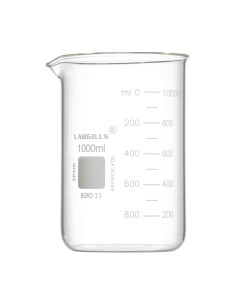
The low-form beaker—also known as the Griffin beaker—is an essential piece of laboratory glassware. Its wide, stable body allows you to heat solutions, dissolve solids, collect filtrates, or perform quick mixes without fear of tipping over. At Pobel, we manufacture these beakers in borosilicate glass 3.3, a material that withstands thermal shocks exceeding 200 °C and retains its transparency even after dozens of autoclave cycles. This level of durability, combined with near-total chemical inertness to acids, bases, and organic solvents, ensures reproducible results and protects your most sensitive reagents.
The low profile reduces the height of the liquid column and speeds up heating, while the extra-thick flat base distributes energy evenly, avoiding hotspots that could cause localized overheating. The spout is molded during the same glass-blowing operation, making it an integral part of the structure and free of microcracks even after repeated use cycles. For quick volumetric readings, the graduation is vitrified with ceramic ink that remains clear and intact after exposure to alkaline detergents and pressurized steam.
The catalog covers capacities from 25 ml to 5,000 ml, following ISO 3819 standards, ensuring that each beaker fits securely in standard rings, grates, and heating mantles. The 600 ml and 1,000 ml versions, highly demanded in organic synthesis, feature additional rim reinforcement to withstand the use of metal clamps for extended periods.
Low-Form Beakers (Griffin): Height-to-diameter ratio is approximately 1.2–1.4. The center of gravity is closer to the base, providing greater stability on the bench and reducing the risk of tipping during manual stirring.
Tall-Form Beakers (Berzelius): Height-to-diameter ratio typically ranges from 1.8–2.0. This slender profile minimizes exposed surface area, limits evaporation, and facilitates decanting solids or immiscible phases.
The Griffin beaker, with its broader base, offers a larger contact area with the heat source, reaching target temperatures faster and with less vertical thermal gradient. In contrast, the Berzelius beaker concentrates liquid in a taller column, making heating more gradual and controlled—ideal for reactions requiring slow gas evolution or foam formation.
The wide mouth of the low-form beaker accommodates large spatulas, glass rods, pH probes, and larger magnetic stir bars, offering convenience during weighing and resuspension operations. The tall-form beaker, with its narrower opening, reduces splashing during boiling but may require longer brushes or automatic washers for thorough cleaning.
Both designs offer full optical clarity with Pobel’s borosilicate glass. However, the shorter liquid column of the Griffin beaker makes it easier to detect fine precipitates or bubbles that might remain hidden at the bottom of a Berzelius beaker of the same volume. Conversely, the taller Berzelius form is preferable when precise meniscus readings or phase stratification control are required.
| Procedure | Recommended Beaker | Main Reason |
|---|---|---|
| Fast heating of buffer or culture medium | Low-Form (Griffin) | Wide base accelerates heat transfer. |
| Decanting solids, slow crystallization | Tall-Form (Berzelius) | Tall column minimizes disturbances and aids sedimentation. |
| Dissolving salts at room temperature | Low-Form | Wide mouth facilitates solid addition and stirring. |
| Reactions with foam formation | Tall-Form | Extra height prevents overflow. |
| Preparing reagents for titrations | Tall-Form | Facilitates precise volume reading and reduces evaporation. |
In research labs, the Griffin beaker acts as an open reactor for dropwise additions, crystallizations, or rapid evaporations. In pharmaceutical and food quality control, it’s used to prepare standard solutions and verify tablet dissolution. Educational departments appreciate its durability in repetitive general chemistry experiments. Pilot plants in cosmetics and detergents use it for stability tests that require continuous stirring and on-site pH monitoring.
Choosing the right volume, optimal wall thickness, or ground-glass neck version can save reagents and time throughout the year. Pobel’s technical team reviews your workflow—maximum temperature, typical volumes, and the chemical nature of your reagents—and sends a personalized quote including an ISO 3819 datasheet and delivery time.
Explore Pobel’s full range of Griffin beakers and work with the reliability demanded by reproducible results.
 Quick delivery
 High quality
 Safe payment