

Your cart
There are no more items in your cart

The beaker is one of the most common, versatile, and recognizable instruments in any laboratory setting—whether in educational environments, scientific research, or industrial applications. Its simple yet functional design allows for a wide range of tasks, making it an indispensable tool for chemists, biologists, technicians, and students. But do we really know what a beaker is used for and how to use it properly? In this Pobel guide, we explain everything.
A beaker is a cylindrical, flat-bottomed container, typically made of borosilicate glass or durable plastic, designed to hold, mix, heat, or react chemical substances.
Beakers are used in a wide variety of laboratory applications. Some of the most common include:
Ideal for dissolving solutes in liquid solvents, as its open shape allows for easy manual or mechanical stirring.
Thanks to its chemical resistance, the beaker is a suitable container for mixing different compounds without risk of adverse reaction with the vessel.
Many glass beakers can be placed on a hot plate or even directly heated over a flame (with proper precautions), making them useful for processes that require temperature increases.
The spout allows safe and controlled transfer of liquids into other containers such as test tubes or funnels.
Beakers serve as suitable environments for chemical reactions that do not require high precision or isolation, such as simple acid-base reactions.
Choosing the right beaker depends on the specific application. Several types exist:
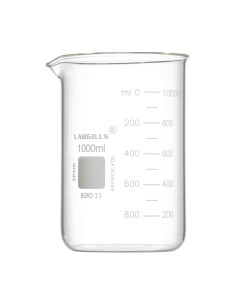
The most common model. Its wider and lower shape provides stability and ease of mixing.
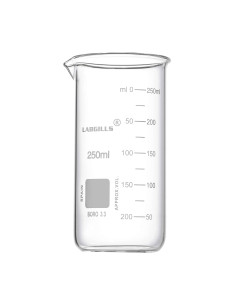
Narrower and taller, ideal for operations that require higher liquid retention when stirring or heating.
When selecting a beaker, it is important to consider:
Proper Cleaning
After each use, beakers should be washed with distilled water and a neutral detergent, then thoroughly rinsed to prevent cross-contamination.
Avoiding Thermal Shock
Do not expose beakers to sudden temperature changes, as even resistant glass can break.
Chemical Compatibility
It is vital to check the compatibility of the beaker with the substances being used, especially for plastic beakers.
At Pobel, we offer a wide range of laboratory beakers tailored to various needs—from basic education to specialized industrial labs. Our products are made with high-quality materials and meet international safety and durability standards.
Visit our online store and discover the available options for your lab.
Yes, if it is made of borosilicate glass. However, it is recommended to use a wire gauze and exercise caution to avoid hot spots.
No. While some have graduations, they are only estimates. For accurate measurements, use volumetric instruments.
The Griffin beaker is ideal due to its low form and wide opening, which facilitate mixing and dissolving substances.
 Quick delivery
 High quality
 Safe payment