

Your cart
There are no more items in your cart
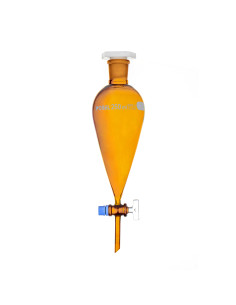
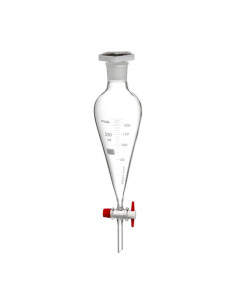
The separatory funnel is an essential tool in chemistry laboratories, especially for separating immiscible liquids and performing liquid-liquid extraction techniques. Its design enables efficient and safe separation, but what often goes unnoticed is that its performance depends largely on the materials it is made of.
This article will delve into the materials that make up the separatory funnel, examining why certain components are chosen over others and how these decisions impact safety, durability, and laboratory efficiency.
The most common separatory funnel material is borosilicate glass. This type of glass is widely used in laboratory equipment due to its high thermal and chemical resistance. Unlike regular glass, borosilicate can withstand sudden temperature changes and exposure to aggressive reagents without deforming or breaking.
Additionally, glass provides transparency, which is crucial for observing the phase separation process in a separatory funnel. This allows users to clearly see the liquid meniscus and decide precisely when to open the stopcock to transfer a phase without contamination.
One of the most critical elements of the funnel is its stopcock. This can be made of ground glass or PTFE (polytetrafluoroethylene), also known as Teflon.
Ground glass stopcocks offer excellent integration with the funnel body and allow for an airtight seal if properly lubricated. However, they can be fragile and require maintenance to prevent breaking or sticking.
On the other hand, PTFE stopcocks are more resistant to friction, require no lubrication, and provide excellent chemical resistance. Teflon is inert to most reagents, making it ideal for demanding lab work.
Although the body and stopcock are the main components, other parts are also worth noting:
• The top stopper: usually made of the same borosilicate glass, though plastic or rubber versions also exist. Its purpose is to seal the funnel during shaking.
• Material variations: there are plastic separatory funnels made of materials like polypropylene. These are occasionally used in educational contexts or industries where glass might pose a breakage risk. However, their chemical and thermal resistance is lower, limiting their use in professional settings.
Choosing the right material for a separatory funnel not only affects the equipment's durability but also the operator’s safety and the quality of experimental results. Chemical and thermal resistance, transparency, and reagent compatibility are crucial factors.
In summary, borosilicate glass combined with a PTFE stopcock offers an optimal solution for most laboratory applications. Understanding the properties of these materials helps in selecting the most suitable funnel according to the sample type and chemical process involved.
Because borosilicate glass offers superior chemical and thermal resistance and provides optimal transparency, which is essential for monitoring the separation process. Plastic, though more impact-resistant, is usually less compatible with aggressive solvents
PTFE stopcocks are more durable, require no lubrication, and are more chemically resistant. However, glass stopcocks can provide a better seal if properly maintained.
It could compromise the funnel's integrity and contaminate the sample. That’s why it’s crucial to check the chemical compatibility between the solvents and the funnel material before use.
Low-quality glass may be more fragile, less resistant to thermal changes, and may contain impurities that compromise transparency or structural integrity.

 Quick delivery
 High quality
 Safe payment