

Your cart
There are no more items in your cart
Separation techniques are essential in chemistry, biology, and many other laboratory disciplines. These processes allow scientists to isolate components, remove impurities, and prepare samples for analysis or further reactions. One of the most effective and widely used tools for this purpose is the separating funnel.
Also known as a decanting funnel or separation funnel, this instrument is used to physically separate immiscible liquids, such as oil and water. In this article, we explore in depth what it is, what the separating funnel is used for, its design, working principle, practical uses, and handling tips. Ideal for students, lab technicians, and professionals.
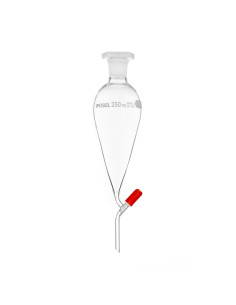
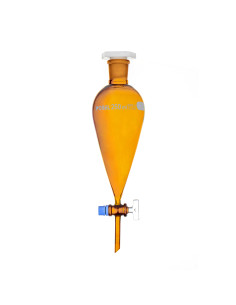
The separating funnel has a conical or pear-shaped body with a stopcock at the bottom and a stopper at the top.
Main Components:
Common Materials:
Variants:
You can find a variety of separatory and addition funnels at Pobel adapted to different needs and volumes.
Principle of Operation
The separating funnel works based on density differences and liquid immiscibility. When the mixture is allowed to settle, the liquids separate into layers: the denser liquid sinks, while the lighter liquid stays on top.
Key Functions:
Applications:
In organic chemistry, the separating funnel is essential for extracting reaction products. It is used to isolate organic compounds dissolved in solvents that are immiscible with water, allowing for efficient recovery of the desired product with minimal loss. In the pharmaceutical industry, this instrument is used in the purification of active pharmaceutical ingredients, making it easier to remove impurities or residual solvents without compromising product quality. In the field of environmental science, the separating funnel helps separate organic pollutants from aqueous samples, playing a crucial role in the analysis of wastewater, rivers, or contaminated soils. Finally, in biotechnology, it is used to separate aqueous phases from organic solvents in the extraction of metabolites, enzymes, or proteins, contributing to the efficient recovery of high-value biotechnological products.
Using a separating funnel provides several advantages in the laboratory. It is a simple yet effective instrument that allows for the controlled separation of complex mixtures. With its stopcock, it offers precise control over liquid flow, enabling the collection of each phase without unwanted mixing. Its versatile design makes it suitable for a wide range of applications and volumes, from small academic experiments to industrial processes.
However, there are important considerations to keep in mind. The separating funnel is not suitable for separating miscible liquids, as these do not form distinct layers. In some cases, emulsions may form, which can hinder or prevent effective phase separation and may require additional techniques. Moreover, it is essential to use a proper support stand and handle the funnel carefully to avoid spills or accidents.
To prevent pressure buildup that can force the stopper out dangerously.
An emulsion is a mixture where liquids don’t separate easily. Centrifugation or separating agents may be required.
A ring stand with a clamp that ensures stability and safety.
Use neutral detergent, rinse with water, and air dry or use lint-free paper.
 Quick delivery
 High quality
 Safe payment