


Your cart
There are no more items in your cart
The purification of substances is a fundamental need in fields such as chemistry, pharmacy, biotechnology, and scientific research in general. Whether it’s to obtain highly pure compounds, perform precise analyses, or synthesize pharmaceutical products, having effective separation and purification techniques is essential.
One of the most effective and widely used methods is crystallization in the laboratory. This technique allows for the separation of pure solid compounds from solutions, and its efficiency largely depends on the laboratory glassware used. This is where the laboratory crystallizer comes into play: a vessel specifically designed to facilitate and optimize the process.
In this article, we will explore what a laboratory crystallizer is, what it’s used for, how to use it step by step, and its key advantages. We’ll also address frequently asked questions to help clarify common doubts.
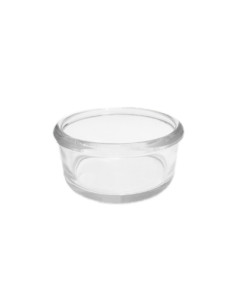
The laboratory crystallizer is a cylindrical container with straight walls and a wide mouth, characterized by having a low height compared to its diameter. This shape is designed to maximize the evaporation surface, which is crucial during the cooling phase of the solvent—when crystallization begins.
It typically does not have a spout or lid, as it is not intended for long-term containment of liquids, but rather to encourage interaction with the environment to induce crystal formation.
Most crystallizers are made from borosilicate glass, a type of laboratory glassware that is highly resistant to thermal changes and chemical corrosion. This material does not react with most reagents and allows the user to visually monitor the crystallization process.
In some industrial or specialized settings, crystallizers may be made of stainless steel, but in laboratory contexts, glass remains the standard.
Crystallizers come in various sizes, ranging from small 50 mL units to larger formats of 2 or 3 liters, depending on the sample size or amount of substance to be purified.
While a beaker might occasionally be used in crystallization processes, it is not designed to optimize this technique. Its tall and narrow shape limits evaporation surface, which slows and reduces crystallization efficiency. So even if they appear similar, beakers are not suitable substitutes when precise and effective crystallization is required.
The primary function of a laboratory crystallizer is to provide an ideal environment for a supersaturated solution to deposit part of its solute as pure crystals. This is achieved through gradual cooling or controlled solvent evaporation.
Crystallization in the laboratory is based on the reduced solubility of a substance as temperature decreases or the solvent evaporates. When a solution reaches its supersaturation point, solute molecules begin to arrange themselves into an ordered structure: the crystal.
The crystallizer provides an open space with a large surface area where this process can occur uniformly, without disturbances that could affect the shape or quality of the crystals.
In all these cases, the use of the crystallizer helps obtain purer products with desirable crystalline characteristics.
Here’s a practical breakdown of how to use a crystallizer in the crystallization process:
1. Prepare the Saturated Solution
Dissolve the substance to be purified in a suitable solvent at a high temperature until it becomes saturated (meaning it can no longer dissolve more solute).
2. Transfer to the Crystallizer
Once the hot solution is ready, filter if necessary and carefully pour it into the laboratory crystallizer, where it will rest to begin cooling.
3. Induce Crystallization
As the solution cools, the solubility of the solute decreases, and crystals begin to form. In some cases, crystallization may be induced by scratching the bottom of the crystallizer with a glass rod or adding a seed crystal.
4. Collect the Crystals
Once crystal formation is visible, they can be separated by vacuum filtration or decanting. The collected crystals will already be in a more purified state.
5. Drying
Crystals should be thoroughly dried to remove any remaining solvent. This can be done at room temperature, in a desiccator, or in a drying oven.
Advantages of the Crystallizer
Considerations When Choosing
Not recommended. While a beaker could be used in emergencies, its shape limits the efficiency of the process and can result in lower-quality or fewer crystals.
Both can be used for crystallization, but a watch glass is mainly for small-scale or fast evaporative crystallization. The crystallizer, on the other hand, allows for greater volume and more controlled conditions.
This could be due to insufficient saturation, temperature not dropping enough, or a lack of crystallization induction. It may be necessary to change the solvent or add a seed crystal.
Rinse immediately after use with distilled water and, if necessary, use a mild detergent. Avoid abrasive products that might scratch the glass. Store it dry and in a safe place to prevent damage and contamination.

 Quick delivery
 High quality
 Safe payment